A World in Ideological Freefall

Preface: This article was originally written as the introduction for a book I am currently in the middle of writing and editing. The working title is, “Ideological Fracture: The Terminal Crisis of Late Stage Capitalism.”
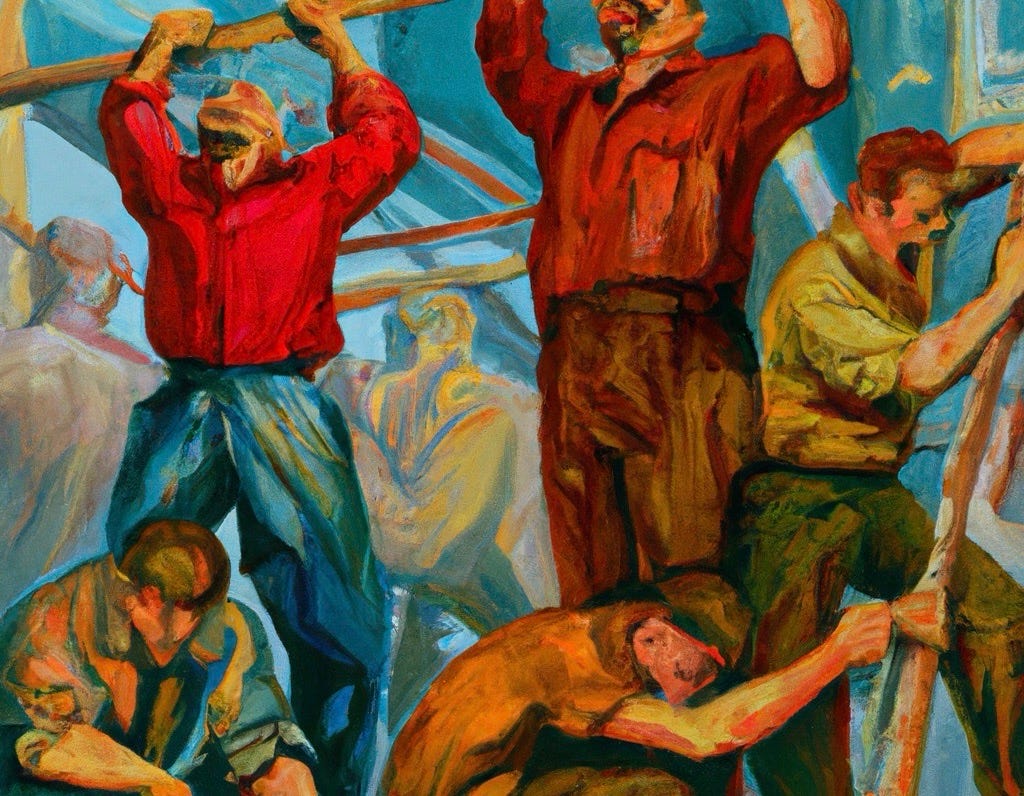
“The old world is dying, and the new world struggles to be born: now is the time of monsters.” — Antonio Gramsci
We live in the twilight of bourgeois hegemony. The ideological scaffolding of global capitalism—liberalism in its various historical mutations—has entered its terminal phase. What confronts us is not simply a crisis within liberal ideology but the naked decomposition of its coherence as a ruling-class weapon. Liberalism, once the dominant ideological regime of the bourgeoisie, now disintegrates under the weight of the very contradictions it was meant to obscure.
This is not a moral crisis. It is not a question of corrupted values or failed leadership. It is a structural unraveling of the ideological order that has historically sutured capitalist domination to the illusions of democratic consent, economic progress, and rational governance. We are witnessing the symptoms of a decaying mode of production that no longer corresponds to the material realities of a planet and population pushed to the brink.
Liberalism's universalist pretenses—freedom, equality, reason—have collapsed into grotesque caricatures. The liberal subject, once posited as sovereign and rational, now appears as what it always was: a juridical fiction masking class exploitation and imperial violence. What remains is not a battlefield of competing ideologies, but an incoherent landscape of disaggregated worldviews: algorithmic tribalism, apocalyptic nihilism, conspiracy-fueled reaction, and technocratic authoritarianism. In the vacuum left by the collapse of liberalism, ideology is stripped of its historical coherence and exists only as a mechanism of control, distraction, and despair.
This book begins from a Marxist hypothesis: that ideological fragmentation is the reflection of a deeper crisis—the inability of the capitalist class to maintain and reproduce ideological hegemony under conditions of intensified economic, ecological, and geopolitical contradiction. The bourgeoisie can no longer rule in the old way, and the masses no longer consent in the old way. Yet the revolutionary alternative has not yet coalesced into a mass political subject. This is the interregnum—the volatile space of ideological struggle where the outcome remains undecided.
To understand this conjuncture, we must excavate the architecture of classical liberalism: its historical emergence as a class ideology, its transformation through the Keynesian compromise, its neoliberal degeneration, and its current mutations. At each phase, liberal ideology has functioned not as a guarantor of freedom, but as a mystification of exploitation, a legitimation of state violence, and a pacification of revolutionary subjectivity.
Ideology, as understood through the lens of historical materialism, is not merely a set of beliefs or political preferences—it is a historically situated framework through which social reality is produced, organized, and made intelligible. It links personal identity to political economy, subjective experience to social totality. The current crisis of ideology, then, is a crisis of sense-making itself: the loss of a dominant worldview capable of interpreting the present and imagining a viable future. We live, to borrow from Fredric Jameson and Mark Fisher, in a world where it is easier to imagine the end of the world than the end of capitalism, even as both systems spiral toward breakdown.
This book begins from the premise that ideological fragmentation is not a temporary disruption but a terminal phase in the history of capitalism. It is the symptom of a deeper structural impasse—one rooted in the contradictions of the capitalist mode of production itself, the failure of liberal political institutions, and the ecological limits of industrial civilization.
Bourgeois universalist claims—freedom, reason, progress, democracy—have been hollowed out by decades of neoliberal restructuring, rising inequality, climate collapse, and digital disinformation. Its institutions have lost credibility; its narratives no longer inspire. The liberal subject—rational, autonomous, and morally sovereign—has given way to an alienated, precarious, and disoriented population grasping for meaning in an increasingly uninhabitable world.
From Coherence to Fragmentation
The liberal order was never without contradiction, but for a long time it functioned as a relatively stable ideological formation. It mediated the social antagonisms of capitalist modernity by projecting an image of incremental progress, economic opportunity, and political inclusion. Even when these promises were only selectively fulfilled—often along lines of class, race, gender, and geography—they nonetheless structured the aspirations and institutions of the modern era. Liberalism shaped everything from constitutional law to cultural production, scientific rationality to moral discourse. It was, in Antonio Gramsci’s terms, the “common sense” of bourgeois hegemony.
However, like the social formations they arise from, ideological formations are not eternal. They are historically contingent and materially grounded. When the social relations that sustain them begin to erode, so too does their coherence. Today, we are witnessing just such a rupture. What replaces this ideological order is not a new synthesis, but a proliferation of competing, incoherent, and often regressive worldviews. Post-truth politics, resurgent nationalism, algorithmic tribalism, technocratic fatalism, and apocalyptic nihilism now dominate the ideological landscape. In the absence of a hegemonic alternative, these fragments circulate without resolution, intensifying the very crises they seek to interpret.
Crisis as a Systemic Condition
The organizing hypothesis of this book is that ideological fragmentation is the expression of a deeper systemic crisis in capitalist society. Late capitalism—characterized by financialization, digital surveillance, labor precarity, and ecological exhaustion—has entered a phase of permanent turbulence. Economic growth has slowed; political institutions have lost legitimacy; the climate crisis accelerates. Capital can no longer deliver on its promises of prosperity, stability, or even survival, yet no viable alternative has fully emerged.
This structural deadlock gives rise to ideological confusion. The decline of liberal hegemony has not been matched by the rise of a coherent counter-hegemonic project. Instead, we see a cultural and political field saturated by disorientation, contradiction, and reaction. Many cling to fragments of liberal ideology (rights, identity, democracy) even as the system that once embodied them collapses. Others gravitate toward authoritarian solutions, conspiracy theories, or nostalgic revivals of traditionalism and nationalism. The terrain is dominated by reaction and resignation.
Yet this ideological breakdown also opens up political possibility. In moments of rupture, when dominant narratives falter and institutions lose legitimacy, there exists a space—however fleeting—for radical imagination and transformative struggle. The challenge is not only to critique the present but to articulate a new ideological horizon grounded in solidarity, ecological balance, and collective emancipation.
Aims and Structure of the Book
This book offers a comprehensive analysis of ideological fragmentation as a defining crisis of advanced capitalism. It is both diagnostic and constructive. The chapters that follow examine how liberalism emerged, transformed, and declined across various dimensions: historical, economic, political, cultural, ecological, and epistemological. Drawing from Marxism-Leninism, critical theory, and postcolonial traditions, this analysis traces the unraveling of liberal ideology and the structural crises that underlie it.
Part I explores the historical development of liberalism, from its classical roots to its neoliberal mutation.
Part II investigates the socio-economic contradictions of late capitalism, including inequality, precarity, and political disintegration.
Part III focuses on the cultural, ecological, and epistemic dimensions of liberalism’s crisis.
Part IV turns to the future: the ideological vacuum left by liberalism, the dangers of fascist resurgence, and the necessity of constructing a new emancipatory worldview.
Throughout, I will argue that ideological fragmentation is not merely a reflection of individual confusion or institutional dysfunction, but a manifestation of deep contradictions within the capitalist mode of production itself. To confront this crisis requires more than policy reform or cultural critique—it demands the reconstitution of collective political subjectivity and the forging of a new ideology adequate to the challenges of our time.
Beyond the Ruins
The stakes are existential. If the ideological void is not filled by a democratic, ecological, and egalitarian alternative (i.e., socialism) it will be filled by fascism, technocracy, and climate catastrophe. The decline of liberalism may mark the end of an epoch, but it need not mark the end of emancipatory possibility. As old certainties dissolve, new horizons must be imagined—not in the abstract, but through the concrete struggles of working people, Indigenous movements, ecological resistance, and revolutionary praxis.
This book is written not as a eulogy for liberalism, but as a call to arms: to understand the crisis we are living through not as the end of history, but as its volatile re-opening. We are, once again, at a crossroads. The future remains unwritten.
Let's make Good Trouble and Strike! FiftyFifty.One has reported that we are winning major battles at the International - Anti-tRump protests! But there are mixed reports on those numbers and we may never know the truth because Führer tRump now controls are news networks. Regardless of the numbers the war against the tRump is far from over. We are still no where near the numbers of persistent Americans resistors we need to end the reign of the Limp Dick Traitor, Führer DonOld tRump, his regime of Musk Rats, Nazi MAGAts, his Battalion of Rich Oligarchs , his ICE Gestapo and his administration from hell.
The 3.5% Rule says that 3.5% of the population (only 11 million in America) must exhibit SUSTAINED RESISTANCE to effectively enact change. The Anti-tRump protests are major wins towards our goal of getting the tRump out of our White House. But the next steps in the Anti-tRump movement must show our commitment to SUSTAINED RESISTANCE.
We must stop The tRump and his administration from hell! The demonic tRump and his billionaire oligarch only care about money. LET'S SHUT THIS FUCKIN’ COUNTRY DOWN!!!
General Strike US supporters are organizing a National Strike. The most powerful strikers are the workers who are employed by the national multi-billionaire companies like Amazon, chain stores and restaurants who have locations in nearly every state across the country, like Amazon, Walmart, McDonald's along with technology and auto, like Tesla, Apple, Meta (Facebook) , Alphabet (Google) workers like these will have the most impact. The rest of us should be boycotting these companies. Keep your money in your own communities and when possible please support small grocery stores, restaurants and businesses instead.
The most important thing Non-Strikers and everyone can do is use your words (verbal or written) to inform everyone about the Strike and the Boycotts. Those that are capable please stop making the greedy billionaire oligarchs even richer. STOP SHOPPING and BUYING from INTERNATIONAL BILLION DOLLAR COMPANIES! Make yourselves richer and buy GROCERIES AND NECESSITIES ONLY until we get the Limp Dick Traitor out the White House and out of our government!!!
Learn more about the
General Strike US: https://onemommy.substack.com/p/the-general-strike?r=113nff
General Strike US Supporters - How Non-Strikers can help! https://onemommy.substack.com/p/general-strike-supporters?r=113nff
Everyone (strikers and supporters) sign up here: GeneralStrikeUS.com
Organizers can/will not write their demands or strike until they have eleven million Americans willing to stop working for the unknown duration of the strike. This strike is for everyone, even for workers without a union. They need organizations, businesses, unemployed workers, retired workers, students, family members, community, etc.- committed to supporting the Strikers during this potentially difficult time. Personally, I believe that if millions of Americans don't show up for work that the billionaire oligarchs will be calling for the immediate resignation of their king - themselves!
To learn more and determine when the time is right to strike, the organizers are asking everyone to sign the General Strike US strike card at GeneralStrikeUS.com. Stand Up America, sign the card and be counted so we can get that true homegrown demented criminal terror out of our lives and get on with the task of rebuilding our democracy and our government. Learn more about how to rebuild visit BernieSanders.com.
Please forward, share or talk about this message with your family, friends, colleagues, even strangers if given the opportunity. Post or repost it on your social media accounts! Substack protesters share this message outside of this political category and get it out to everyone. It's going to take ALL of us to bring down the tRump, the billionaire oligarchs (who hog the money you earn) and the Administration from Hell!
Let’s build a
force bigger than fear
and louder than hate.
Let’s get ready.
Let’s get organized.
Let’s stop the tRump.
One Million Rising
teaches coordinated national strategic actions to locally organize, host community gatherings, and build a force bigger than fear, to bring down the tRump and his administration from hell.
Search
"One Million Rising"
on YouTube and/or Mobilize.us
to sign up or post an event.